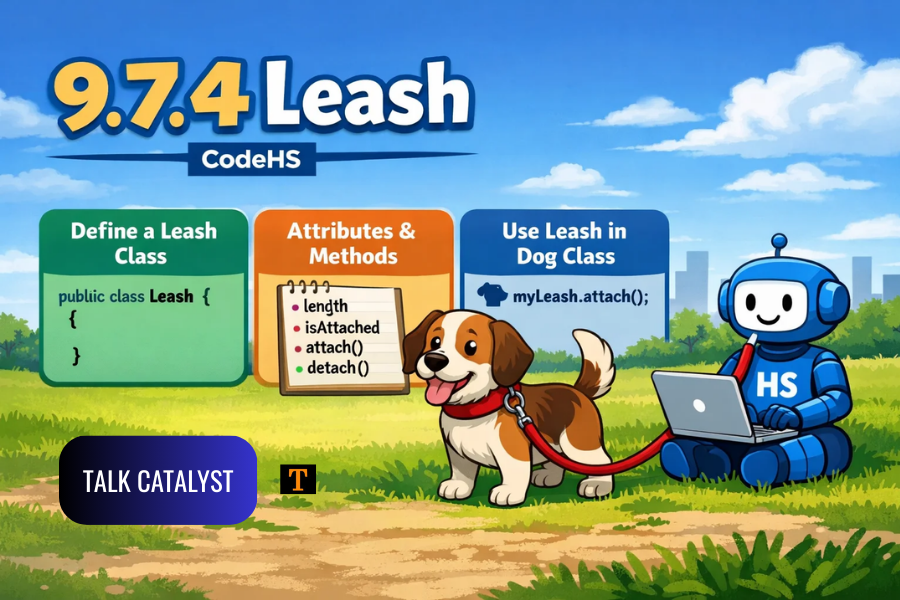
If you are trying to find Leash CodeHS Answer Solutions, probabilities are you’re running through the CodeHS Animation and Games module and have reached one among its maximum memorable exercises: the nine.7.Four Leash program.
At first look, it looks simple. A yellow ball follows your mouse, and a skinny black line connects it to the middle of the screen. But after you begin constructing it yourself, you quick realise this exercise teaches much more than a way to draw shapes. It introduces you to event-driven programming, variable scope, object positioning, and real-time user interplay — middle standards utilized in expert software and sport development.
In this comprehensive guide, you will not just get floor-stage leash CodeHS answers. You will recognize how the program works, why it works, and how to regulate it optimistically. This article is written certainly, professionally, and in alignment with modern-day seek great standards, making sure correct motives and sensible insight.
Let’s damage it down step by step.
What Is the 9.7.4 Leash Program in CodeHS?
The 9.7.4 Leash assignment in CodeHS is an interactive animation exercise. The objective is to:
- Create a yellow ball centered on the screen.
- Draw a black line starting from the center.
- Make the ball follow the mouse cursor.
- Stretch the line from the center to wherever the mouse moves.
The result looks like a dog attached to a leash. The center of the screen acts as the anchor point, the ball is the “dog,” and the line is the leash.
While many students look for quick leash CodeHS answers, the real value comes from understanding how the program listens to mouse events and responds instantly.
This is one of the first exercises where students experience real-time interaction — not just drawing shapes, but making objects respond dynamically.
Core Concepts Behind the Leash CodeHS Answers
Before diving into code structure, let’s understand the main programming ideas behind this exercise.
1. Event-Driven Programming
The leash program works because it reacts to mouse movement. Instead of using loops that constantly check for changes, the program waits for an event.
When the mouse moves, a specific function runs automatically.
This pattern is called event-driven programming, and it is used in:
- Video games
- Drawing applications
- Mobile apps
- Web interfaces
The 9.7.4 leash is your first exposure to this concept.
2. Global Variables
One of the most common mistakes students make when searching for leash CodeHS answers involves variable scope.
You must declare certain variables globally so multiple functions can access them.
If you accidentally redeclare them inside a function using var, you create a new local variable. This breaks the connection between functions.
Understanding scope is critical not just for this assignment, but for all future programming work.
3. Coordinate System
CodeHS uses a coordinate grid:
- (0, 0) is the top-left corner.
- X increases as you move right.
- Y increases as you move down.
The leash program depends entirely on correct X and Y coordinates from the mouse event.
Step-by-Step Breakdown of the Leash CodeHS Answers
Now let’s explain the structure clearly.
Step 1: Declare Constants and Global Variables
You typically begin with:
- A constant for the ball radius
- A global variable for the ball
- A global variable for the line
Why global?
Because both the start() function and the mouse event function must access the same ball and line objects.
If you redeclare them inside start(), the event function won’t update the correct objects.
This is one of the biggest debugging issues students face.
Step 2: Create the Start Function
The start() function runs automatically when the program begins.
Inside it, you:
- Create the line.
- Position both endpoints at the center (making it invisible at first).
- Add the line to the canvas.
- Create the circle.
- Position the ball at the center.
- Add the ball to the canvas.
- Register the mouse movement function.
The key detail:
Both endpoints of the line start at the same coordinates. That means the line has zero length initially.
When the mouse moves, only the endpoint changes.
Step 3: Handle Mouse Movement
The magic happens in the event function, commonly named something like endPoint(e).
The parameter e represents the event object. It contains mouse data.
You retrieve:
- The X coordinate using
e.getX() - The Y coordinate using
e.getY()
Then you:
- Move the ball to those coordinates.
- Update the line’s endpoint to match those coordinates.
The start of the line never moves. It stays anchored at the center.
This creates the leash effect.
Why Students Struggle with Leash CodeHS Answers
Many learners try to copy code without understanding the mechanics. That usually leads to frustration.
Here are the most common issues:
1. Forgetting to Add Objects to the Canvas
Creating an object does not automatically display it. You must explicitly add it using add().
If you forget to add the ball or line, nothing appears.
2. Using the Wrong Event Method
Some students accidentally use:
mouseClickMethod()instead ofmouseMoveMethod()
When this happens, the ball only moves when clicked.
The leash program requires continuous movement tracking.
3. Redeclaring Variables
Using var ball = inside start() instead of assigning the global variable breaks the connection between functions.
This causes the ball to stop responding correctly.
4. Mixing Up Coordinates
Confusing X and Y values or using invalid properties (like e.x) instead of e.getX() causes errors.
Understanding Scope in Depth
Variable scope is one of the most important lessons in this assignment.
Global variables:
- Declared outside functions
- Accessible everywhere
Local variables:
- Declared inside functions
- Only usable within that function
If your event function cannot see the correct ball object, the program will not update properly.
Professional developers deal with scope issues daily. Learning this now builds strong foundational skills.
Real-World Applications of the Leash Concept
The 9.7.4 leash is not just a classroom exercise.
The same logic appears in:
Video Games
Crosshairs following the mouse.
Turret aiming systems.
Dragging objects.
Graphic Design Software
Brushes following stylus movement.
Selection tools.
User Interface Design
Drag-and-drop interactions.
Interactive sliders.
Understanding leash CodeHS answers means understanding how modern interfaces respond to users in real time.
Advanced Modifications You Can Try
Once your basic leash program works, try expanding it.
1. Change the Leash Color
Experiment with different colors.
2. Adjust Line Thickness
Make the leash thicker for stronger visual impact.
3. Follow Only While Dragging
Replace the move method with mouseDragMethod().
4. Add Boundary Control
Prevent the ball from leaving the screen by checking limits.
5. Add Multiple Balls
Create two balls that both follow the mouse with separate lines.
6. Random Color Changes
Change the ball’s color every time the mouse moves.
Experimentation builds deeper understanding.
Frequently Asked Questions About Leash CodeHS Answers
Why does my ball move but the leash does not show?
You likely forgot to add the line to the canvas or update its endpoint.
Why does nothing appear?
Check that:
- You added both objects.
- Your
start()function is defined correctly. - No variable was accidentally redeclared.
Why does my ball disappear off screen?
There is no boundary restriction by default. Add conditions to keep it inside visible coordinates.
Do I need to memorize this for exams?
Yes. Event handling, coordinate systems, and scope frequently appear in assessments.
How to Think Like a Programmer While Solving This
Instead of copying leash CodeHS answers, ask yourself:
- Where is my object created?
- Who can access it?
- When does the event fire?
- What coordinates am I using?
Professional programming is about logical flow, not memorization.
Debugging Strategy for Leash CodeHS
If something breaks:
- Confirm global variables are declared properly.
- Ensure you did not use
varagain inside functions. - Verify both objects were added.
- Print X and Y values to confirm event data.
- Check spelling of method names carefully.
Small typos cause major issues.
Why This Assignment Matters More Than You Think
The leash program represents a turning point for many students.
It shifts programming from static drawing to interactive behavior.
You are no longer writing instructions that run once. You are building systems that react continuously to user input.
That shift in thinking is foundational for:
- Game development
- App development
- Web design
- Software engineering
Mastering this small program gives you confidence to build bigger projects.
Also Read More: AI Regulation News Today
Final Thoughts on Leash CodeHS Answers
If you came here looking for quick leash CodeHS answers, you now have something better: understanding.
The 9.7.4 leash program teaches:
- Event-driven programming
- Variable scope
- Real-time coordinate tracking
- Object manipulation
It may look simple, but it contains core programming principles used in professional environments.
Take time to experiment. Modify it. Break it intentionally and fix it again.
That process is how real programmers grow.
When your ball smoothly follows your cursor and the leash stretches naturally behind it, you are not just completing an assignment.
You are learning how software listens.
And that skill will stay with you far beyond CodeHS.